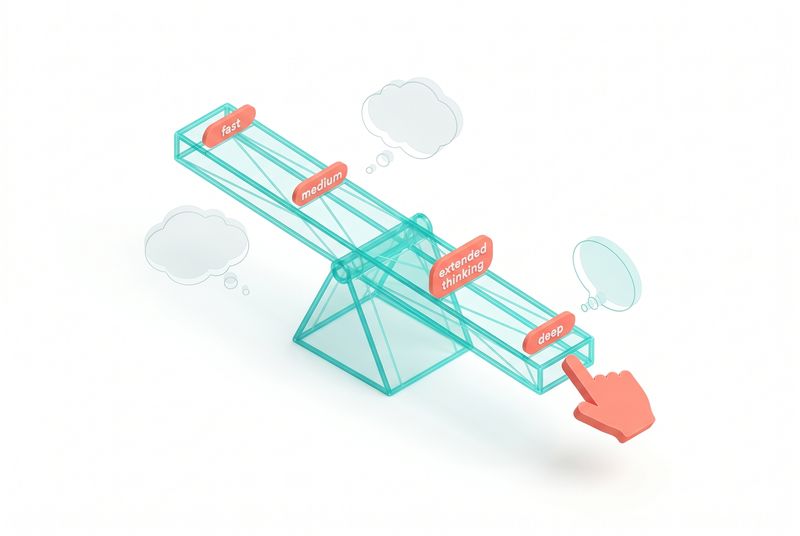
Most teams I work with are configuring their Claude deployments wrong in one specific way.
They treat thinking as a switch. On for hard tasks. Off to save money.
Alexander Bricken from Anthropic's Applied AI team made the case at Code with Claude London that this is the wrong mental model.
When you disable extended thinking, you are not asking the model to think less. You are removing a capability the model would otherwise reach for when the problem deserves it.
Adaptive thinking, which is how current Claude models work, gives the model agency over its own reasoning rhythm. It can think three times in a row if the task is hard. It can skip thinking entirely on something trivial. The model decides.
Bricken's analogy: we do not tell Claude to never use search, or always use search. We give it the tool and trust it to choose. Thinking should work the same way.
The right knob is effort, not capability.
Effort controls how much budget the thinking tool has when the model does choose to use it. Anthropic ships extra high as the default on Claude Code and Claude.ai because it sits at a defensible Pareto point between intelligence, latency, and tokens.
Max effort exists for the hardest tasks. The curve flattens fast. Most production work does not need it.
Three practical moves I am taking into client work:
- Stop disabling thinking to save money. Dial effort down instead.
- Pick model size before tuning effort. A big model on low effort almost always beats a small model on max effort.
- Log effort settings alongside model and prompt. You will need that field the first time you debug a quality regression.
The lever is in your hand. Treat it that way.
Full breakdown of the talk: [LINK]