The Calculator Feeling Is Back, and It Can Write Distributed Systems Now
Three key takeaways
- The keynote frames the current moment as a return to the giddy, tinkering feel of programming a TI-83 in TI Basic at age 13, except the thing you describe to the machine can now be a distributed system. The friction between "I have an idea" and "it runs" has collapsed to something close to zero.
- Customer wins make the curve concrete. Spotify is merging over a thousand PRs a month with background Claude Code agents, cutting migration time by more than 90%. Binty took 20 days off the process of licensing a foster family. Mythos read the entire OpenBSD source tree and found a 27-year-old vulnerability that survived every human reviewer and every static analyzer.
- The gap that matters now is not capability, it is adoption shape. Model capability is on an exponential. Most organizations are on a linear. The work for developers is to architect for the next version of Claude, not the current one, because the teams who win are the ones whose scaffolding is ready to absorb the next jump.
The opening keynote for Code with Claude London 2026 starts with a story about a Texas Instruments calculator. Anthropic's Boris Cherny tells the audience he learned to code on a TI-83, writing little programs in TI Basic so he could reference them during math tests. It worked. He got great scores. He taught his classmates. At 13 he published a guide to programming scientific calculators on the internet.
He follows it with a second story. Same age, HTML this time, not for a startup, but to make his eBay listings of Pokémon cards look better than the competition. Tables, blinking text, holographic legendary birds for 99 cents each. The story closes with a small confession about wishing he had kept the cards. The audience laughs. Then he gets to the point.
"We didn't learn to program from a textbook. We learned from tinkering. And I still remember the giddy feeling that I got when one of my calculator programs ran. You made the thing and it did what you wanted."
That feeling, he argues, went away for a while. Compilers, type checkers, build systems, package managers, twelve config files before you could write a single line of code. The distance between "I have an idea" and "it runs" kept getting longer.
The talk's thesis is that the distance is collapsing again, and it is collapsing fast.
The Calculator Feeling, At Scale
The line that does the heavy lifting in the keynote is this one:
"You describe a problem and the program shows up. It's the calculator feeling except the calculator can write a distributed system."
That single image carries the rest of the talk. Once you accept it, three things follow.
The first is that the people who already feel it know how to talk about it. The second is that the customer stories shift from "AI saved us time" to "AI did a thing that was impossible before". The third is that the gap between what is possible and what most organizations are doing keeps widening, and someone has to close it.
The keynote spends most of its time on the second and third points. The customer stories are deliberately picked to span the range from infrastructure speed to mission-driven impact to research-grade discovery.
Spotify, Binty, Mythos
Three names worth keeping in your head from this keynote.
Spotify. A team led by Nicholas Gustiffson built a background agent on Claude. It reads a migration described in plain English and runs that migration across a fleet of agents, opening pull requests as it goes. The number is more than a thousand PRs merged into production every month. The reduction in migration time is more than 90%. The way Boris phrases it: "That's real engineering hours back."
Migration work is the unglamorous, never-finished tail of any large engineering org. Every framework version, every API deprecation, every internal library that finally got renamed. The work that fills sprint planning meetings and never gets celebrated. Spotify points a fleet at it overnight. The PRs land. Humans review. Engineering hours that were going into mechanical refactors go into something else.
Binty. Felicia Coruru is the CEO. Her software runs the systems that case workers use to place kids in foster care. Paperwork, home visits, licensing. The team used the Claude API to give case workers back the hours they used to spend on paperwork. They took 20 days off the licensing process for a foster family.
The way the keynote frames it is the part that sticks. "It's not just an efficiency metric. That's a kid connecting with a family. 20 days." Twenty days off a process that gates kids out of homes is not a developer productivity story. It is a different story about the same tooling.
Mythos. This is the discovery story. Last month, Mythos read the entire OpenBSD source tree and found a 27-year-old vulnerability that survived every human reviewer, every fuzzer, and every static analyzer ever pointed at it. Three decades of careful, expert security review missed it. A model read the codebase and saw it.
These three stories sit at different points on the same curve. Spotify is volume and speed at scale. Binty is mission impact for a domain that does not usually get the attention of frontier AI. Mythos is the case where a model does something humans literally could not.
The keynote does not dwell on Mythos. It gets a sentence and a half. But the sentence does the work for the rest of the argument.
The Exponential and the Linear
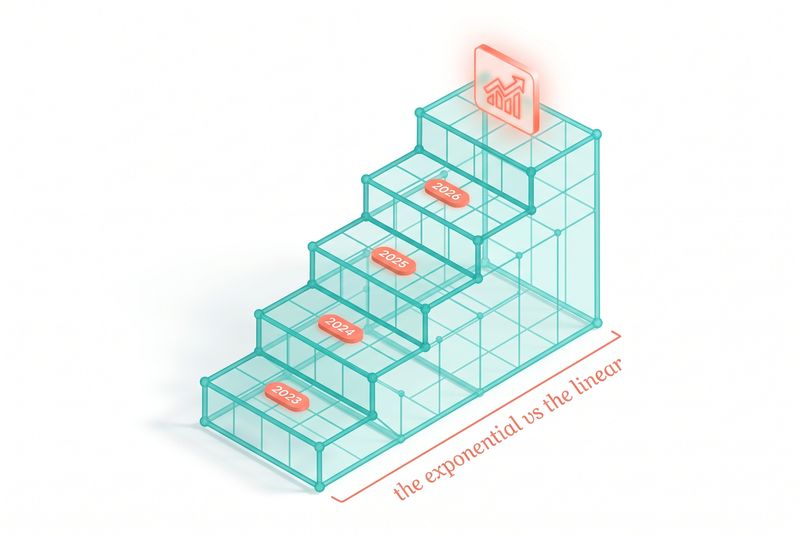
The argument the rest of the keynote is built around is direct. Model capabilities are improving on an exponential curve. Most organizations are adopting AI on a linear path. There is a growing gap, and the gap is the interesting thing.
"There's a growing gap between what AI can do and what it's actually doing for people. Closing that gap and translating model capability into something that people can actually use is what you all as developers do."
The numbers Anthropic gives to back the claim:
- API volume on the Claude platform up nearly 17x year over year.
- The average Claude Code developer is now running Claude more than 20 hours a week.
The 20-hours-a-week number is the one that should make you pause if you are still treating coding agents as a sometimes tool. Twenty hours a week is more than half of a developer's coding time. That is not an experiment. That is the workflow.
Lisa Su, from the research PM team, takes the stage to put the model side of this in a frame. She has been at Anthropic since 2023 and has shipped 17 versions of Claude. Her capability curve looks like this:
- Opus 3: first model proficient at writing long-form code.
- Sonnet 3.5/3.6: first model that could use a computer safely.
- Sonnet 3.7: first model that thinks before answering.
- Opus 4: first model that could write complex Excel files and PowerPoint documents.
- Opus 4.7 and Mythos preview: models that own outcomes end to end and apply judgment to high-ambiguity tasks.
Eight frontier models shipped in twelve months. Each one building on the last.
Her framing for what changes as models get better is worth quoting:
"As model intelligence increases, the value of use cases increases exponentially. So consider coding. Agentic coding is far more impactful than code autocomplete. In this way, incremental intelligence creates new markets and grows the pie."
This is the actual argument behind "build for the next version of Claude, not the current one". The point is not that future models will be slightly better at the same tasks. The point is that capability jumps unlock categories of work that did not exist before, and the unlocks are not incremental. They are step changes.
Computer use was a step change. Tool use was a step change. Thinking that adapts to the task was a step change. Agentic loops that hold a plan over hundreds of steps was a step change. Long context windows was a step change. The next ones, by Lisa's framing, are higher judgment and code taste, context windows that feel effectively infinite, and multi-agent coordination on goals too big for any one agent.
Task Horizon as the Measurable Variable
The metric Lisa points at to make the change legible is task horizon. How long can a model work before losing the thread.
"Last year at this time, models could reliably work for minutes. And today, most users have agents that run for hours. We expect future generations of Claude to run continuously."
Continuously is the load-bearing word. The argument is that future Claude agents will be proactive and always on, responsible for high-level goals that require judgment and collaboration. The shift in framing from "Claude, write a project update" to "Claude, keep the project on track this week" is the right one to internalize now.
The implication for anyone building on the platform is uncomfortable. If you optimize your scaffolding for what works today, you are building for the floor, not the ceiling. The scaffolding that helps a less capable model often holds a more capable one back. Lisa's phrasing:
"Claude is intelligent and resourceful, and more intelligent models can often get further with generalized primitives like a file system and sandbox computing environment."
The harder your prompts, the tighter your rails, the more brittle your evals, the more work you will have to do at every model upgrade to undo your own scaffolding.
Practical Direction for Builders
The keynote is not abstract. It tells you what to do.
Make harder evals and product prototypes. "When a task that used to fail starts passing, that's your sign to ship something that you couldn't ship before." This is the cleanest articulation I have heard of the upgrade-as-shipping-opportunity pattern. Your evals are your seismograph. If your evals all pass on every model, your evals are too easy.
Automate your evaluation pipeline. Every model upgrade should be a low-friction event for you. "The teams who are getting the most out of Claude are the ones who treat model upgrades as a business opportunity."
Test hands-on. Read your own outputs. Touch the new capabilities. The numerical lift in benchmark scores is not what matters. What matters is the new shape of what the model can do.
Architect for the next version. Generalized primitives over special-cased scaffolding. File systems and sandboxes over hand-tuned tool chains. The teams whose architecture is ready to absorb the next big jump are the ones who win.
The Platform Side and the Cloud Code Side
The keynote splits into three layers after the opening: the foundation (model layer, Lisa), the platform (Angela and Caitlyn), and Claude Code itself (Cat and Boris).
The platform updates worth noting:
- Advisor strategy. A Sonnet-class model executes; an Opus-class model advises when the smaller model gets stuck. The numbers Anthropic cites: Sonnet plus Opus advisor outperformed Sonnet alone, and did it more cheaply, because Opus advised it to get the work done better. Eve Legal reports frontier model quality at five times lower cost.
- Claude Managed Agents. An agentic harness paired with production-grade infrastructure. The promise is 10x faster to ship, with production-grade agents in days rather than months. Asana built AI teammates on this.
- Self-hosted sandboxes. Run Claude's code execution on your own infrastructure. First-class support for Daytona, Cloudflare, Vercel, and Modal sandboxes.
- MCP tunnels. Expose your internal MCP servers to Claude Managed Agents without putting them on the public internet. Gateway in your private network, secure tunnel to Anthropic, agents reach them without exposure.
The Claude Code updates worth noting:
- Multi-clotting got first-class UI. The desktop app gives you a single view of every session, local and cloud, with indicators for running, blocked, and needing input. The CLI got an agents view for people who stay in the terminal.
- Code review as an agent team. A team of agents traverses your code changes and auxiliary files to catch critical bugs. Used by thousands of companies, including every internal Anthropic team.
- Mobile remote control. iOS and Android. Touch grass, get tasks done.
- Autofix. Listens for flaky CI, code review comments, and merge conflicts, fixes each one proactively so your PR is always green.
- Routines. Configure once, Claude Code runs on a schedule or in response to a webhook or API call. The work that used to require you to manually kick off now just happens.
- Claude Security. Scans your codebase overnight, ranks vulnerabilities by severity, lets you kick off Claude Code to address each one.
The detail Boris closes the demo with is the one I want to leave you with:
"The default isn't 'I'm going to prompt Claude Code'. The default is now 'I'm going to have Claude prompt Claude Code'."
Routines as a higher-order prompt. You write the prompt that writes the prompts. The work shifts up a level.
Mercado Libre, Shopify, and the Manager Who Codes Again
The Cat segment closes with two enterprise stories that deserve their own beat.
Shopify uses Claude Code across the entire company, not just engineering. Product managers, designers, data scientists. Andrew McNamera, director of applied AI, calls the speed "just crazy" and says Claude Code has transformed how they build internal tools.
Mercado Libre, Latin America's largest e-commerce platform, has 23,000 engineers running on Claude Code. They have reviewed over 500,000 PRs with human oversight and modernized over 9,000 apps. Oscar Mowen, who leads technology, is aiming for 90% autonomous coding in a fully agent-driven PR loop by Q3.
The line that caught me was Boris's aside about Mercado Libre:
"But the detail I love the most isn't just the number. It's that managers and VPs who haven't committed code in years are now shipping again. Cloud Code is putting coding back in the hands of people who've spent the last decade in reviews and roadmap sessions instead of in their codebase."
This is the calculator feeling again, but for the people who lost access to it through promotion. Engineering managers who used to ship code now spend their days in meetings about other people's code. Claude Code gives them a way back. The feeling is contagious because it works for the indie dev and the VP equally.
What This Adds Up To
Three layers of one story. Lisa's capability curve at the model level. Angela and Caitlyn's agents on infrastructure you control at the platform level. Cat and Boris's developer surfaces at the Claude Code level. Each layer is real, each layer is shipping, and each layer is built on the assumption that the next jump is coming sooner than you think.
The line that lands hardest is the one I have been turning over since the talk:
"The capability is already here, and the remaining gap is how fast we put it to work."
That is the assignment. The capability exists. The exponential is doing the work on Anthropic's side. The linear is what your organization is currently on. The gap between those two curves is what gets closed by developers who build for what is coming, not for what is here.
The calculator feeling is back. The calculator can write distributed systems now. The question is whether your team has the scaffolding to keep up when the calculator gets smarter again next month.
Marco Kotrotsos, specializing in practical AI implementation for organizations ready to close the gap between AI hype and AI value. With 30 years of IT experience now focused purely on AI deployment, he works hands-on with companies to turn AI potential into measurable business outcomes.
This article is published in Autocomplete, a Medium publication about real-world AI for practitioners and decision-makers.
My free Substack newsletter, also called Autocomplete, can be found here: https://acdigest.substack.com.
Source talk: Code with Claude London 2026: Opening Keynote. https://youtu.be/6amLO7I9xdg