Rakuten reported a 97 percent drop in first-pass errors after deploying Anthropic's new agent memory primitive.
Harvey, the legal AI company, reported a 6x increase in completion rates on their legal benchmark with dreaming enabled.
These are not benchmark wins. They are production deployments at scale.
Ravi from Anthropic's API knowledge team presented memory and dreaming at Code with Claude London. Two design choices stood out to me.
First, memory is modeled as a file system. Not a vector database. Not a knowledge graph. A directory with files. The reasoning is that Claude is already strong at navigating file systems because models trained on source code have spent more time looking at files than at any other data store. Building a custom abstraction asks the model to learn your abstraction. Files just work.
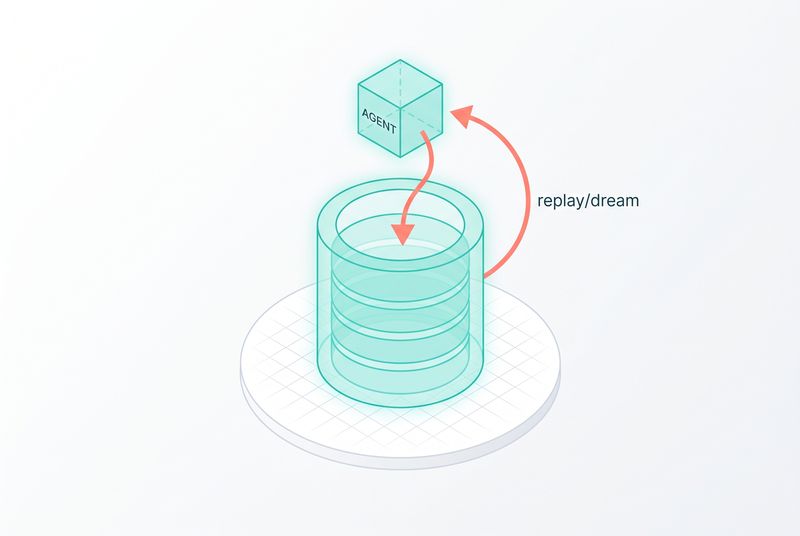
Second, dreaming is a separate process that runs out of band. It reviews session transcripts across agents, identifies recurring patterns and inefficiencies, and rewrites the shared memory store. Live agents pay no latency cost. The expensive analysis happens offline. The artifact gets served online. Same architecture as background indexing in search engines or batch training in ML systems.
The combination closes the learning loop. Agents write memory as they work. Dreaming refines memory across sessions. The next generation of agents reads better memory. Their sessions feed the next dreaming run. Memory raises the floor for every agent. Dreaming raises it further.
Three practical moves for teams running agents in production:
- Stop building custom retrieval abstractions on top of capabilities the model already has.
- Audit where agent knowledge lives today. Consolidate org-wide content like runbooks and policies into a memory store with the right scope.
- Decide a dreaming cadence deliberately. Nightly is a reasonable default. The point is to not let memory drift unattended.
The companies that operate inside this loop will compound their agent performance in ways single-agent shops will not match.
Full breakdown: [LINK]